
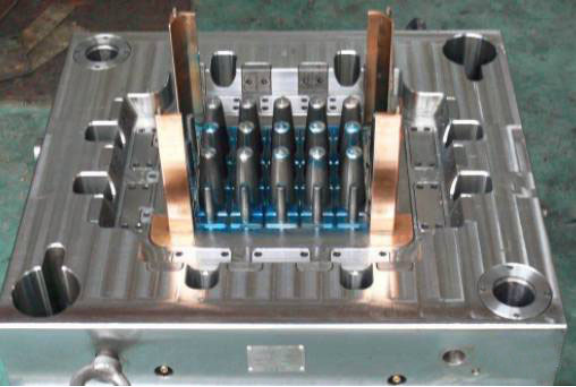
Guide post damage
Guide pillars mainly serve a guiding function in molds to ensure that the forming surfaces of the core and cavity do not collide under any circumstances. Guide pillars cannot be used as load-bearing or positioning components.
In the following two cases, the moving and fixed molds will generate huge lateral offset forces during injection:
When the wall thickness of the plastic part is not uniform, the material flow rate is high when passing through the thick wall, which generates greater pressure at this point;
the sides of the plastic part are asymmetrical, such as in a mold with a stepped parting surface, where the reaction pressure on the opposite sides is not equal.
Difficulty in removing material from the gate
During injection molding, the gate becomes stuck inside the gate bushing and is difficult to remove. When the mold is opened, the product develops cracks and damage.
Furthermore, the operator must use the tip of a copper rod to tap it out from the nozzle to loosen it before demolding, severely impacting production efficiency.
The main cause of this failure is poor surface finish of the gate conical hole, with tool marks on the circumference of the inner hole. Secondly, the material may be too soft, causing deformation or damage to the small end of the conical hole after a period of use.
Additionally, the nozzle’s spherical curvature may be too small, resulting in rivet heads forming at this point in the gate material. The conical hole of the gate bushing is difficult to machine; standard parts should be used whenever possible.
If machining is necessary, a custom-made reamer should be used or purchased. The conical hole must be ground to a Ra value below 0.4. Furthermore, a gate pull rod or gate ejection mechanism must be installed.
Moving and fixed mold offset
Large molds, due to varying filling rates in different directions and the influence of the mold’s own weight during assembly, can experience displacement between the moving and stationary molds.
In these cases, lateral offset forces will be applied to the guide pillars during injection, causing surface roughening and damage to the guide pillars during mold opening. In severe cases, the guide pillars may bend or be cut off, or even prevent mold opening altogether.
To address the above issues, high-strength locating keys are added to each of the four sides of the mold parting surface; cylindrical keys are the simplest and most effective method.
The perpendicularity of the guide pillar holes to the parting surface is crucial. During machining, the moving and fixed molds are aligned and clamped, then bored in one pass on a boring machine.
This ensures the concentricity of the moving and fixed mold holes and minimizes perpendicularity errors. Furthermore, the heat treatment hardness of the guide pillars and guide bushings must meet the design requirements.
Bending of the moving template
During injection, the molten plastic inside the mold cavity generates enormous back pressure, typically between 600 and 1000 kg/cm².
Mold manufacturers sometimes neglect this issue, often altering the original design dimensions or replacing the moving platen with a low-strength steel plate.
In molds using ejector pins, the large span between the two side seats causes the platen to bend downwards during injection.
Therefore, high-quality steel with sufficient thickness must be selected for the movable formwork. Low-strength steel plates such as A3 should never be used.
If necessary, support columns or support blocks should be installed under the movable formwork to reduce the thickness of the formwork and improve its load-bearing capacity.
The push rod is bent, broken, or leaking material.
Self-made ejector pins are of better quality, but the processing cost is too high. Currently, standard parts are usually used, but their quality is generally lower. If the gap between the ejector pin and the hole is too large, material leakage will occur.
However, if the gap is too small, the ejector pin will expand and jam during injection due to the increased mold temperature. Even more dangerously, sometimes the ejector pin breaks after being ejected a certain distance, and as a result, this exposed section of the ejector pin cannot return to its original position during the next mold closing, damaging the mold cavity.
To solve this problem, the ejector rods were reground, retaining a 10-15 mm mating section at the front end and reducing the middle section by 0.2 mm. After assembly, all ejector rods must have their mating clearance strictly checked, generally within 0.05-0.08 mm, to ensure the entire ejection mechanism can move forward and backward freely.
Poor cooling or water leakage in the water system
The cooling effect of the mold directly affects the quality of the product and production efficiency. Poor cooling can lead to excessive shrinkage of the product or uneven shrinkage, resulting in defects such as warping and deformation.
On the other hand, overheating of the mold, either as a whole or in parts, can prevent the mold from forming properly and cause production to stop. In severe cases, it can cause moving parts such as ejector pins to expand and jam, resulting in damage.
The design and processing of the cooling system should be determined by the shape of the product. Do not omit this system because the mold structure is complex or the processing is difficult. In particular, the cooling problem must be fully considered for large and medium-sized molds.
The guide groove length is too small.
Some molds, due to limitations in template area, have guide groove lengths that are too short. After the core-pulling action is complete, the slider protrudes outside the guide groove.
This can easily cause slider tilting during the later stages of core pulling and the initial stages of mold closing and resetting. Especially during mold closing, the slider may not reset smoothly, leading to damage or even bending.
Based on experience, the length of the slider remaining in the guide groove after the core-pulling action should not be less than 2/3 of the total guide groove length.
Malfunction of the fixed-distance tensioning mechanism
Fixed-distance tensioning mechanisms such as swing hooks and latches are generally used in molds for core pulling or some secondary demolding.
Because these mechanisms are set in pairs on both sides of the mold, their actions must be synchronized, that is, they latch at the same time when the mold is closed and disengage at the same time when the mold is opened to a certain position.
Once synchronization is lost, the mold plate being pulled will inevitably become skewed and damaged. These mechanisms require parts with high rigidity and wear resistance, are difficult to adjust, and have a short lifespan.
Their use should be avoided as much as possible; alternative mechanisms can be used. When the core-pulling force is relatively small, a spring-driven method can be used to push out the fixed mold.
When the core-pulling force is relatively large, a structure where the core slides as the moving mold retracts, completing the core-pulling action before mold separation, can be used. For large molds, hydraulic cylinders can be used for core pulling. Damage to the inclined pin slider type core-pulling mechanism is also a concern.
The most common problems with this type of organization are inadequate processing and insufficient material usage, mainly the following two issues:
A large tilt angle A in the slanted pin
design has the advantage of producing a larger core-pulling distance within a shorter mold opening stroke.
However, if an excessively large tilt angle A is adopted, when the pulling force F is a certain value, the bending force P=F/COSA on the inclined pin during the core pulling process will also be greater, which will easily lead to deformation of the inclined pin and wear of the inclined hole.
Simultaneously, the greater the upward thrust N=FTGA generated by the inclined pin on the slider, the greater the force.
This force increases the normal pressure of the slider on the guide surface inside the guide groove, thereby increasing the frictional resistance during slider sliding. This can easily lead to uneven sliding and wear of the guide groove. Based on experience, the inclination angle A should not exceed 25°.


