
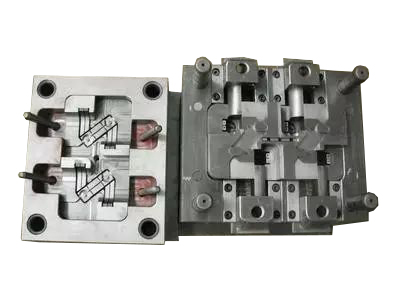
Single parting surface injection molds
When the mold is opened, the moving mold and the fixed mold separate to remove the plastic part. This is called a single parting surface mold, also known as a double-plate mold. It is the simplest and most basic form of injection mold.
It can be designed as a single-cavity injection mold or a multi-cavity injection mold as needed. It is the most widely used type of injection mold.
Double parting surface injection mold
Double parting surface injection molds have two parting surfaces. Compared with single parting surface injection molds, double parting surface injection molds add a partially movable intermediate plate (also called a movable sprue plate, which has a sprue, runner and other parts and components required by the fixed mold) to the fixed mold part.
Therefore, it is also called a three-plate (moving plate, intermediate plate, fixed plate) injection mold. It is often used for single-cavity or multi-cavity injection molds with point gate feeding.
When the mold is opened, the intermediate plate separates from the fixed plate on the guide pillar of the fixed mold at a certain distance so that the solidified material of the gating system can be taken out between the two plates.
Double parting surface injection molds have a complex structure, high manufacturing cost and difficult parts processing. They are generally not used for molding large or extra-large plastic products.
Injection molds with side parting and core pulling mechanisms
When the plastic part has side holes or side recesses, a side-moving core or slider is required for molding. After injection molding, the moving mold first moves downward a certain distance, and then the inclined section of the bent pin fixed on the fixed platen forces the slider to move outward.
At the same time, the ejector rod of the demolding mechanism pushes the ejector plate to remove the plastic part from the core.
Injection mold with movable molding parts
Due to certain special structures of plastic parts, injection molds are required to have movable molding components, such as movable punches, movable dies, movable inserts, movable threaded cores or rings,
which can be removed from the mold along with the plastic parts during demolding and then separated from the plastic parts.
Automatic unscrewing threaded injection mold
For threaded plastic parts, when automatic demolding is required, a rotatable threaded core or ring can be set on the mold.
The threaded core or ring can be rotated by the mold opening action or the rotation mechanism of the injection molding machine, or by setting a special transmission device, thereby demolding the plastic part.
Runnerless injection mold
Runnerless injection molds refer to injection molds that use a method of insulatingly heating the runner to keep the plastic between the injection molding machine nozzle and the cavity in a molten state,
so that no solidified material from the gating system is injected when the mold is opened and the plastic part is removed. The former is called an adiabatic runner injection mold, and the latter is called a hot runner injection mold.
Right-angle injection mold
Right-angle injection molds are only suitable for angle injection molding machines. Unlike other injection molds, the feeding direction of this type of mold is perpendicular to the mold opening and closing direction during molding.
Its main runner is located on both sides of the parting surface between the moving and fixed molds, and its cross-sectional area is usually constant, which is different from the molds used in other injection molding machines.
To prevent wear and deformation of the injection molding machine nozzle and the inlet end of the main runner, replaceable runner inserts can be set at the end of the main runner.
Injection mold with demolding mechanism on fixed mold
In most injection molds, the demolding device is installed on the moving mold side, which facilitates the operation of the ejection device in the injection molding machine’s mold opening and closing system.
In actual production, due to the shape limitations of some plastic parts, it is better to leave the plastic part on the fixed mold side for molding.
Therefore, in order to remove the plastic part from the mold, a demolding mechanism must be set on the fixed mold side.
Contact Person: Alex
WhatsApp/ WeChat: 0086 18968677763
Email: [email protected]
Website: www.solidcomould.com


