
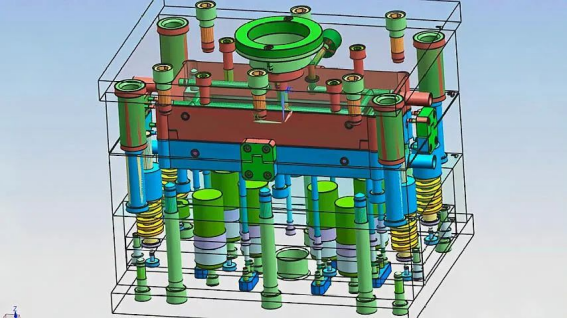
Composition of the gating system
A typical runner system, also known as a gating system or injection system, is the essential channel through which molten plastic flows from the injection nozzle of an injection machine to the mold cavity. The runner system includes the primary runner, sub-runners, and gates.
Primary Runner
Also known as the main runner, sprue, or vertical runner, it refers to the runner system extending from the point where the injection nozzle contacts the main runner bushing of the mold to the branch runner.
This is the first part of the mold through which molten plastic flows after entering the mold.
Branch Runner
Also known as a secondary runner or sprue. Depending on the mold design, it can be further divided into a first runner and a second runner.
The runner is the transition area between the main runner and the gate, allowing for a smooth transition in the flow direction of the molten plastic; for multi-cavity molds, it also has the function of evenly distributing plastic to each cavity.
Gate
Also known as the sprue, it is the narrow opening between the runner and the mold cavity, and is also the shortest and thinnest part. Its function is to accelerate the flow of plastic by utilizing a constricted flow surface;
a high shear rate ensures good plastic flowability (due to the shear-thinning properties of plastic); the viscous heating effect also increases the material temperature and reduces viscosity.
After molding, the sprue is the first to solidify and seal, preventing plastic backflow and avoiding excessively rapid pressure drop in the mold cavity, which could cause shrinkage and depressions in the molded part.
After molding, it is easy to cut away to separate the runner system and the plastic part.
Cold Slug Well
Also known as a cold slug well. Its purpose is to store and collect the cooler plastic wavefront during the initial stage of filling, preventing cold slug from directly entering the mold cavity, affecting filling quality or clogging the gate.
Cold slug wells are usually located at the end of the main runner; when the branch runners are long, cold slug wells should also be installed at the ends.
Basic Principles of Gating System Design
Cavity Layout Considerations
Use a balanced layout whenever possible;
Strive for symmetry between the cavity layout and gate location to prevent uneven stress on the mold, which can lead to overflow and other problems;
Make the cavity layout as compact as possible to reduce mold size.
Flow Guidance Considerations
- Ensure smooth guidance of molten plastic to fill the cavity without creating eddies and allowing for proper venting;
- Minimize direct impact of molten plastic on small-diameter cores and metal inserts to prevent core shift or deformation.
Heat Dissipation and Pressure Drop Considerations
- Minimize heat loss and pressure drop;
- Keep the flow path short;
- Ensure a large enough cross-sectional area for the runner;
- Minimize bends and sudden changes in flow direction in the runner (use rounded corners to change direction);
- Maintain low surface roughness during runner machining;
- Multi-point gating can reduce pressure drop and required injection pressure, but may introduce seam defects.
Flow Balance Considerations
- In multi-cavity filling, the runner system should be balanced to ensure that plastic fills each cavity simultaneously, guaranteeing consistent product quality.
- Runners should ideally be arranged in a naturally balanced layout.
- If natural balancing is not possible, manual balancing should be used.
Waste Considerations
To minimize waste generation and recycling costs, runner volume (length or cross-sectional area) should be reduced without affecting flow or pressure loss, while ensuring smooth filling.
Cold Slug Considerations
Appropriate cold slug wells and overflow channels should be designed in the runner system to collect the colder plastic wavefront at the initial filling stage, preventing cold slug from directly entering the cavity and affecting filling quality.
Venting Considerations
The system should smoothly guide plastic to fill the cavity and allow air to escape smoothly, avoiding encapsulation and scorching issues.
Considerations for Molded Part Quality
- Avoid problems such as short shots, burrs, encapsulation, seam lines, flow marks, jetting, residual stress, warpage, and core misalignment;
- When the runner system is long or has multiple gating points, warpage caused by flow imbalance, insufficient holding pressure, or uneven shrinkage should be prevented;
- The product should have a good appearance, easy gate removal and trimming, and gate marks should not damage the appearance or application of the plastic part.
Considerations for Production Efficiency
Minimize post-processing to shorten the molding cycle and improve production efficiency.
Considerations for Ejection Points
Consider appropriate ejection points to avoid demolding deformation of the molded part.
Considerations for Plastic Use
Use plastics with high viscosity or short L/t ratios, and avoid using excessively long or small runners.
Contact Person: Alex
WhatsApp/ WeChat: 0086 18968677763
Email: sc10@solidcomould.com
Website: www.solidcomould.com