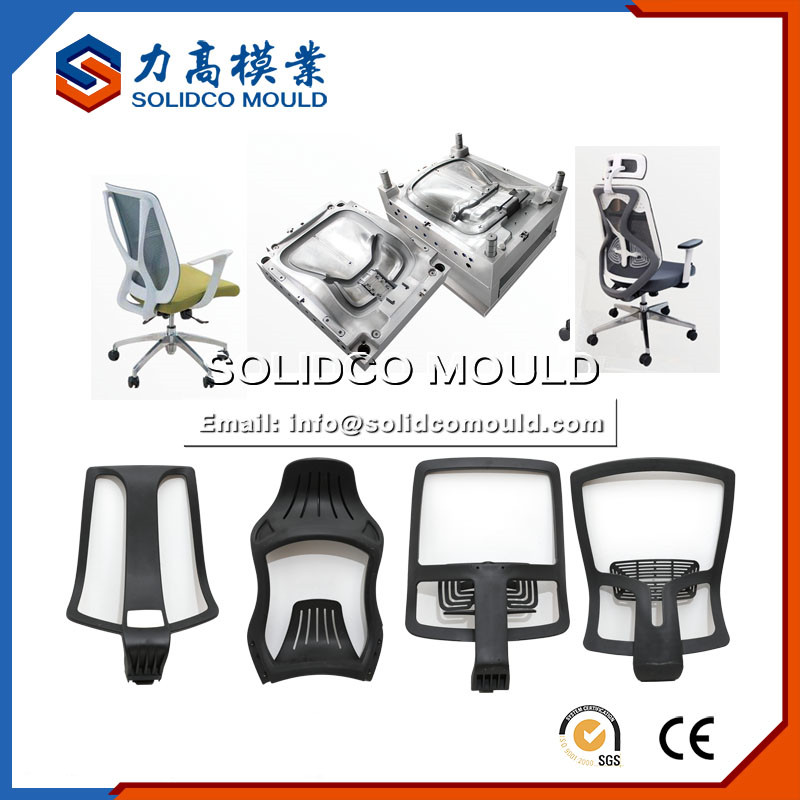
In the competitive world of office furniture, there is a saying: “You know a chair by sitting in it; we know its quality by the mold it comes from.”
For brand owners and OEM manufacturers, an office chair mold is far more than just a production tool. It is the decisive factor determining product precision, structural durability, and delivery timelines. Today, let’s bypass the marketing jargon and take you onto the factory floor for a technical复盘 (review) of how a high-quality mold—specifically for complex components like glass-filled backrests and mechanical bases—is forged.
1. Design & Engineering: Where Precision Begins
Before a single cut is made in the steel, the outcome is already determined by the design.
A superior office chair mold starts with meticulous CAD/CAE engineering. Unlike simple plastic parts, ergonomic chairs feature complex curves (S-curved backs, waterfall seats) that require zero tolerance for error. At this stage, our engineers perform Mold Flow Analysis (MFA). This simulation predicts weld line locations, air trap risks, and shrinkage rates before production begins.
For molds involving intricate mesh inserts or ventilation holes, gate location and cooling channel design directly impact your production yield. We adhere to a “zero trial-mold failure” philosophy, solving problems in the computer rather than wasting time on the injection molding machine.
2. Steel Selection: The Foundation of Longevity
Office chair production often demands million-shot cycles. Therefore, material selection is non-negotiable.
- Core Cavity Steel: For high-wear parts like the chair base or tilt mechanisms, we exclusively use premium steels from suppliers like ASSAB (Sweden) or DAIDO (Japan), such as 718H or S136. These are hardened to 33-38 HRC to ensure corrosion resistance and polishability.
- Standard Mold Base: We utilize LKM standard mold bases to guarantee rigidity and parallelism during high-speed cycling.
Using substandard steel leads to flash, burrs, and eventual cracking—resulting in costly production line downtime.
3. Precision Machining: The Micro-Meter Battle
Step into our CNC machining center, and you will hear the symphony of high-frequency cutting. This is where craftsmanship meets technology.
- High-Speed Milling (HSM): To achieve the smooth curvature of an ergonomic backrest, we use high-speed machining centers. This ensures surface roughness (Ra) stays below 0.8μm, minimizing manual polishing labor.
- Electrical Discharge Machining (EDM): For deep ribs and complex textures that CNC cutters cannot reach, mirror-grade EDM is employed to burn the exact shape into the steel.
4. Injection Molding Simulation: The “First Shot”
Once assembled, the mold undergoes a rigorous testing phase. We run scientific molding procedures to find the optimal injection speed, holding pressure, and cooling time.
For office chairs, dimensional stability is critical. A deviation of just 0.5mm can cause the chair to squeak or fail BIFMA/X5.1 safety standards. We conduct comprehensive inspections using CMM (Coordinate Measuring Machines) to ensure every cavity produces parts within spec.
5. Why Your Mold Supplier Matters
Choosing a mold supplier is not about finding the cheapest quote; it’s about finding a partner who understands Total Cost of Ownership (TCO).
A cheap mold might save you $5,000 upfront but could cost you $50,000 in scrap rates, maintenance, and delayed shipments later. Our commitment is to provide molds that offer:
- Cycle Time Efficiency: Optimized cooling lines for faster ejection.
- Part Consistency: No sink marks on the seat pan.
- Structural Integrity: Perfect fusion for glass-fiber reinforced plastics (GFRP).
Ready to upgrade your office chair production?
Whether you need a rapid prototype mold or a full-scale production die for a new ergonomic series, our engineering team is ready to assist. Contact us today for a technical consultation and a detailed DFM (Design for Manufacturability) report.