
Custom office chair mould cost is not a commodity price. Two quotations for the same chair backrest can differ by 30% — and both suppliers may still be pricing honestly.
It is a production asset rated for a defined number of shots, cycle time and part quality. This guide breaks down what really drives tooling cost, so buyers can compare offers on total cost per part instead of the upfront number.
What Really Drives Custom Office Chair Mould Cost?
- A validated process: DFM analysis, mould design optimization, mould trial and sample approval.
- A rated tool life: steel grade, heat treatment, wear surfaces and spare inserts.
- A supported launch: installation guidance, parameter setting, mould maintenance and troubleshooting after shipment.
The real cost equation is: tooling + trials + scrap + downtime + maintenance, divided by validated shots.
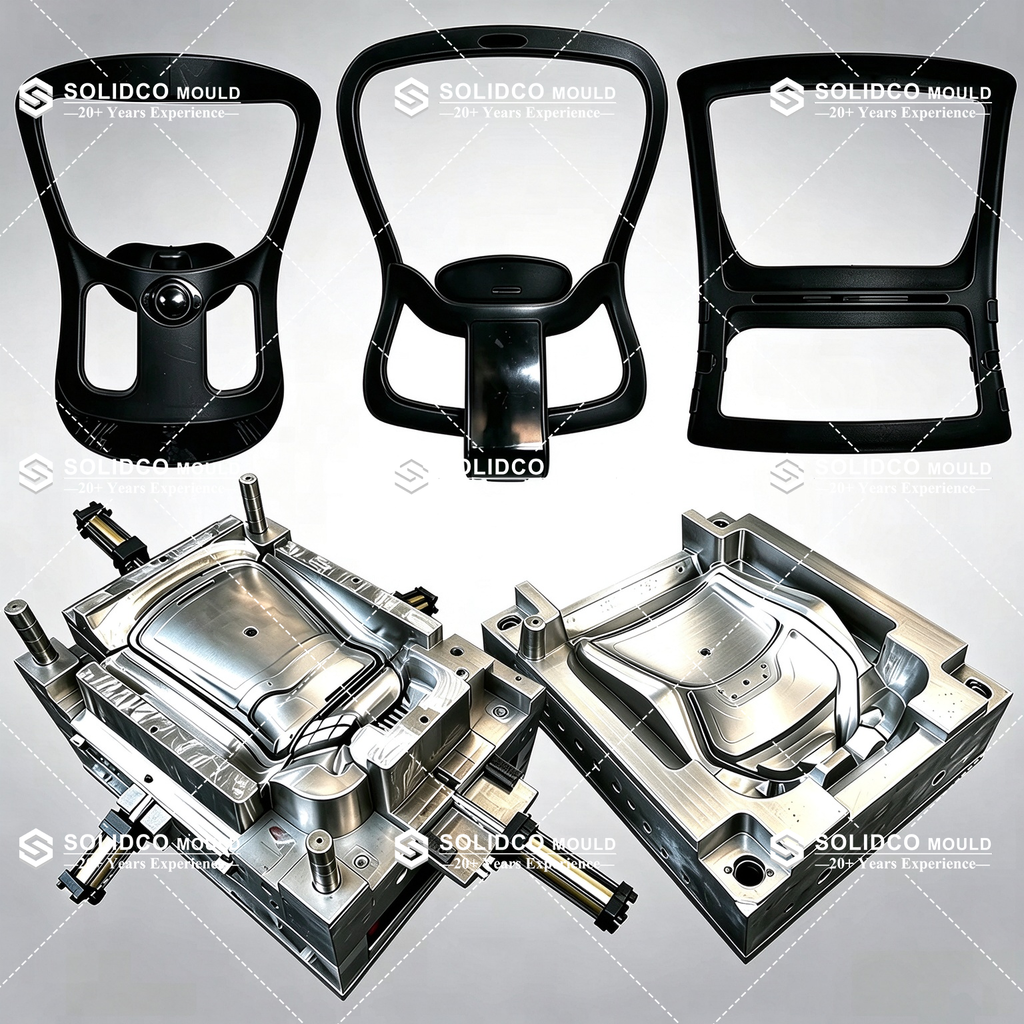
7 Hidden Factors That Drive Custom Office Chair Mould Cost
1. Cavity Count and Annual Volume
- A single-cavity prototype tool and a multi-cavity production tool require very different steel size, machining hours and runner balancing.
- Share expected annual volume upfront. Our recent high-cavity chair mould programme was engineered around a defined annual cycle target, not a generic long-life claim.
2. Part Geometry, Undercuts and Inserts
- Sliders, lifters, interchangeable inserts and deep cores add machining and fitting hours.
- Modular inserts can raise the initial quote but let one mould base run several armrest or lumbar variants.
3. Mould Steel and Heat Treatment
- P20 / 718H suit neutral resins and moderate volumes; H13 / 1.2344 or hardened, nitrided grades suit glass-filled resins and long runs.
- GF-PP is abrasive. Saving on steel here usually returns as wear, flash and rework. See our steel–resin selection guide.
4. Runner System: Cold or Hot Runner
- Cold runner: lower upfront cost, simpler maintenance, practical when colours change frequently.
- Hot runner: less runner scrap, better gate cosmetics and cycle efficiency at high volume — with a higher initial cost.
5. Cooling Strategy
Conventional drilled channels are economical. Conformal cooling adds printed inserts but can remove a hot-spot bottleneck on large, curved backrests. Plastics Technology documents the mechanism and the trade-offs here: https://ptonline.com/articles/conformal-cooling-helps-get-heat-out-and-cycle-times-down
6. Surface Class and Cosmetic Requirements
Class-A finishes, textures, polishing grade and gate vestige limits all add process hours and inspection criteria. Define them in the RFQ so both sides inspect to the same standard.
7. Validation Scope and After-Sales Support
Number of mould trial rounds, FAI / dimensional report timing, 24–72 h post-ejection measurement, export crating, and remote or on-site commissioning support all belong in the quotation.
A 3-Line Custom Office Chair Mould Cost ROI Check
- Cost per validated part = (tooling + maintenance + scrap + downtime) ÷ validated shots.
- Cycle time sensitivity: 2 seconds saved per shot × 500,000 shots = 1,000,000 seconds ≈ 278 machine hours recovered.
- A cheaper tool that runs 3 seconds slower or needs an extra T1 round can erase the saving within one production year.
Ask each supplier to state the assumed cycle time, rated tool life and trial scope in writing. Those three numbers make custom office chair mould cost quotes comparable.
Custom Office Chair Mould Cost: 4 Red Flags in Low Quotes
- No mould steel grade, hardness or heat-treatment documentation.
- No DFM report before CNC machining.
- Only one mould trial round, with no defined modification terms.
- No written after-sales or mould maintenance support.
We covered the lifecycle cost of these shortcuts in 4 hidden risks of cheap quotes. You can also browse our mould categories on the Alibaba store: https://solidco.en.alibaba.com/
Frequently Asked Questions
Q: Why does custom office chair mould cost vary so much between suppliers?
A: Because suppliers assume different steel grades, cavity counts, trial rounds and support scope. Ask for a line-item specification, not just a total.
Q: Is a hot runner always worth it?
A: Only when volume, resin cost and runner scrap justify it. For short runs or frequent colour changes, a well-designed cold runner is often the better economic choice.
Q: What should a quotation include at minimum?
A: Steel grade and hardness, cavity count, runner type, expected cycle time, rated tool life, trial and sample scope, dimensional report timing, and after-sales terms.
The Bottom Line
Compare custom office chair mould cost quotes on documented steel, DFM depth, mould trial scope and cost per validated part — never on the upfront price alone.
For a transparent, line-item custom office chair mould cost quotation, send your 2D/3D drawings, resin grade and annual volume to [email protected] or WhatsApp +86-13386587702.
💬WhatsApp / Phone: +86-13386587702


