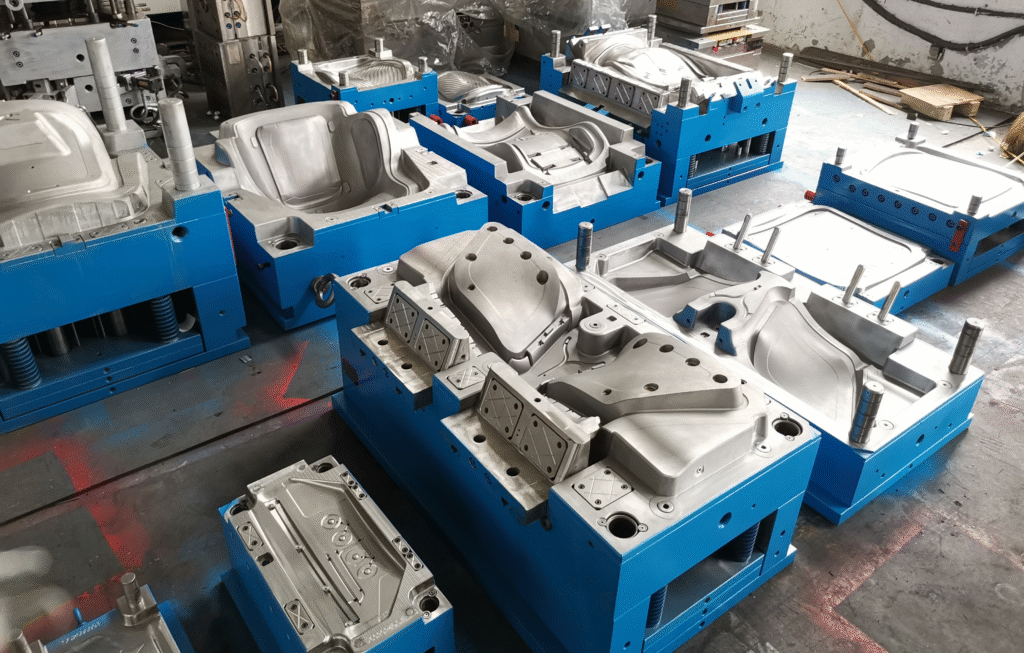
In short, a good injection mold is stable, durable, easy to run, maintainable, and suitable for mass production, with highly consistent molded parts.
Below are the widely recognized standards in the industry for what a quality mold should be.
1. Simple and Reliable Structure, Not Overly Complicated
The top feature of a good injection
mold: keep it simple whenever possible.
- Use a two-plate mold instead of a three-plate mold if feasible
- Use ejector pins instead of lifters, and lifters instead of complex hydraulic cylinders
- Minimize slides and core-pulls, with smooth movements
Poor molds have complex mechanisms, high failure rates, and require numerous trials.
Good molds feature minimal structure, smooth operation, and almost no jamming.
2. Smooth Opening and Closing, No Jamming or Abnormal Noise
You can judge quality simply by operating it:
- Guide pins and bushings fit smoothly with no roughness or wobble
- Slides move lightly and return accurately, without collision or noise
- Ejector system is balanced, with no deflection or shaking of the ejector plate
A good mold opens and closes as smoothly as a well‑hung door, not by force.
3. High Precision Cavity and Core, with Proper Clearance
- Tight fitting parting surface, almost no flash
- Stable hole positions, bosses, and dimensions with consistent batch quality
- Moderate clearance for inserts and pins, no flashing or seizing
A good mold is basically 合格 on the first trial (T1), with no major modifications needed.
4. Well‑Designed Cooling System for Uniform Temperature
This is a key marker of mold quality.
- Balanced cooling channels close to part walls, ribs, and deep cavities
- High cooling efficiency for short cycle times
- Parts free from warpage, deformation, and sink marks
Poor molds have messy cooling and uneven temperature, causing severe deformation and long cycles.
Good molds ensure uniform temperature, stable parts, and high productivity.
5. Efficient Venting, No Short Shots, Burning or Bubbles
A good mold always prioritizes proper venting:
- Venting grooves at parting lines, flow fronts, and weld lines
- Appropriate depth (0.02–0.05 mm) to vent air without flashing
- Additional venting via inserts in deep ribs and dead spots
Trials show no burning, short shots, bubbles, or yellowing from trapped gas.
6. Balanced Ejection, No White Marks, Cracks or Sticking
- Properly positioned ejector pins for even force distribution
- Synchronized movement of lifters, ejector sleeves, and stripper plates
- Sufficient draft angles and well‑polished surfaces
- Parts release easily, sticking to neither the cavity nor the core
A good mold ejects cleanly, with no white marks or deformation.
7. Optimized Gate Design for Better Appearance and Lower Stress
- Gates positioned away from cosmetic surfaces
- Proper size for smooth filling and minimal weld lines
- Clean automatic degating without secondary trimming
- Effective packing to reduce sink marks
Parts from a good mold have clean surfaces with little to no post‑processing.
8. Appropriate Steel Selection for Long Service Life
Quality means matching steel to the part, not just using expensive materials.
- Standard ABS/PP: P20, 718
- High‑polish and transparent parts: NAK80, S136
- Glass‑filled or corrosive materials: corrosion‑resistant and wear‑resistant steels
A good mold runs hundreds of thousands of cycles with minimal wear, scratches, or rust.
9. Easy Maintenance, Disassembly and Repair
Professional molds are designed for practicality:
- Full use of standard components (universal ejector pins, guide pins, springs)
- Removable inserts for easy maintenance and polishing
- Clear, unclogged, leak‑proof cooling channels
- Standardized slides and lifters for convenient replacement
Poor molds break easily during disassembly and require extensive repairs.
Good molds have low maintenance costs and allow easy cavity or insert changes.
10. Excellent Mass Production Stability and High Consistency
The ultimate measure of a good mold is:
Consistent part dimensions and appearance over thousands to tens of thousands of cycles.
- Stable dimensions with no drift
- Consistent part weight
- Extremely low reject rate (below 0.5% or even lower)
Summary in Simple Terms
- Simple structure, smooth operation with no jamming
- Effective cooling and venting, no deformation or burning
- Clean ejection, good appearance, stable dimensions
- Durable and maintainable, stable in production with long service life