
Office chair mould runner system decisions are usually made in the RFQ — and then paid for on every shot for the rest of the tool’s life. Choose the wrong one and you either discard runner scrap on every cycle, or carry a hot runner premium your volume never pays back.
For large chair components — backrests, seat pans, five-star bases — the runner also sets fill balance, weld-line position and gate vestige on Class-A surfaces. It is a DFM decision, not a procurement line item.
Why the Office Chair Mould Runner System Sets Your Piece Price
With a cold runner, the runner solidifies and is ejected with the part. You pay for that material, for the cooling time it needs and for trimming or regrind handling. With a hot runner, a heated manifold keeps the melt molten to the gate: no runner scrap, smaller gate marks and more consistent multi-cavity filling — but higher upfront tooling cost, temperature controllers and a maintenance plan.
Run this before choosing: annual runner cost = runner weight per shot × annual shots × resin price per kg. Compare it with the hot runner premium, controller cost and expected maintenance over the same period. Tooling decisions made on a cost-per-part lens rather than upfront price are the ones that hold up in production; see the runner and cooling cost discussion at https://plastictech.com/?p=905
One caveat buyers often miss: a hot runner does not automatically shorten the cycle. On a large, flat backrest, cooling is usually the bottleneck. Plastics Technology documents where real cycle-time gains come from: https://ptonline.com/articles/conformal-cooling-helps-get-heat-out-and-cycle-times-down
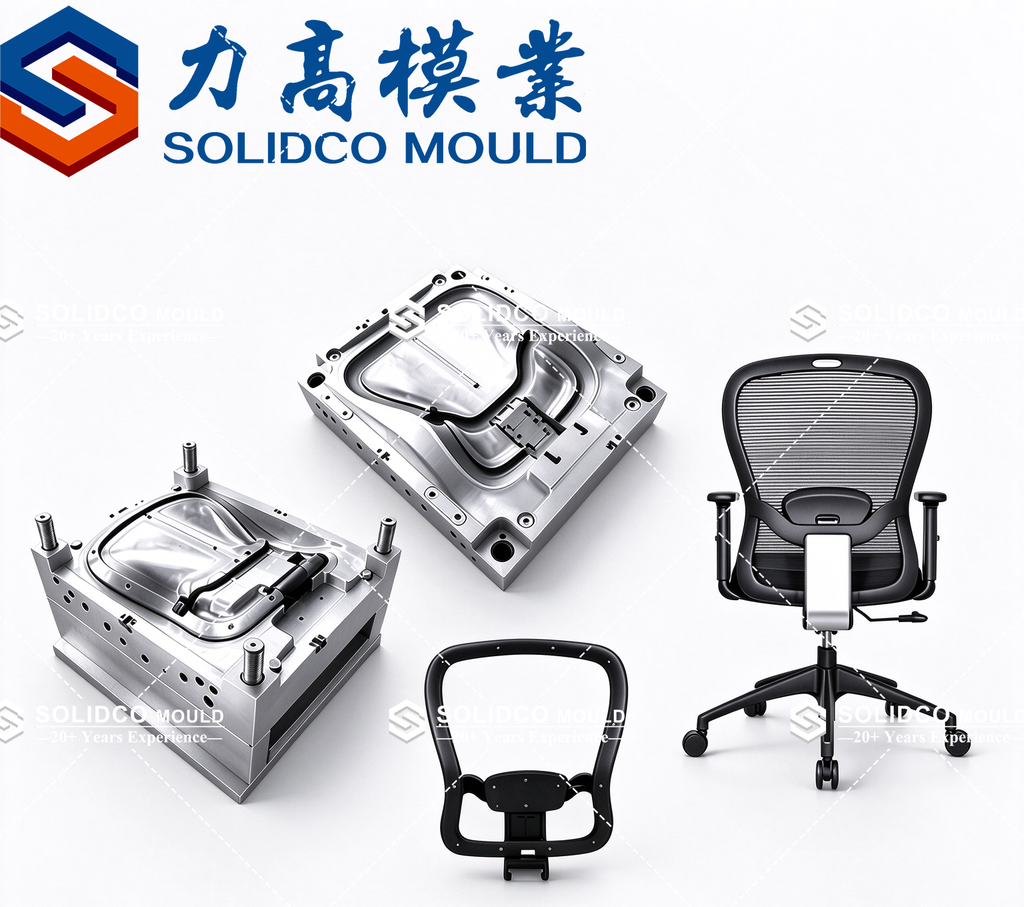
Hot Runner or Cold Runner: 7 Proven Rules for an Office Chair Mould Runner System
1. Annual Volume and Resin Price
High volume plus expensive or glass-filled resin pays back a hot runner quickly. Low volume, commodity PP and frequent colour changes usually favour a well-designed cold runner.
2. Colour Change Frequency
Cold runners purge fast. Hot runners hold melt in the manifold, so colour or material changes need a documented purge procedure and carry a degradation risk for heat-sensitive resins.
3. Gate Vestige and Class-A Surfaces
Pin or valve gates leave small marks and suit visible shells; edge and fan gates simplify machining but need trimming. Gate type, location and venting should be reviewed together in DFM — see https://www.plasticmoldcompany.com/injection-mold-dfm-gate-cooling-runner-strategy/ and the gate-type comparison at https://www.longteamtw.com/blog/injection-molding-gate-types-design-guide
4. Multi-Cavity Fill Balance
For high-cavity chair moulds, a hot runner with valve gates can improve shot-to-shot consistency. A cold runner can still perform well, but the runner layout must be shear-balanced and verified in mould flow analysis before steel is cut.
5. Glass-Filled Resins and Wear Parts
GF-PP is abrasive. In any office chair mould runner system carrying filled resin, specify hardened nozzles and gate inserts, and agree a spare-parts list before T1. Fibre orientation also follows flow, so gate position affects warpage — review it together with the cooling layout.
6. Maintenance Capability at Your Plant
A hot runner adds heaters, thermocouples, controllers and seals. Confirm your team can calibrate zones, replace a heater and hold spare nozzles; otherwise the theoretical scrap saving turns into unplanned downtime and mould maintenance cost.
7. Validate in the Production Resin
Trialling in a convenient substitute resin makes the fill-balance data largely irrelevant. Run the mould trial in the actual production material and record first article inspection dimensions at 2 h, 24 h and 72 h post-ejection.
What to Confirm in the RFQ About Your Office Chair Mould Runner System
- Manifold and nozzle brand, nozzle count and number of temperature-control zones.
- Gate type, gate location and a drawing of where the vestige will sit on the part.
- Colour-change and material-purge procedure, including expected purge shots.
- Wear-part and spare-list: nozzles, heater bands, thermocouples, seals and inserts.
- Hot runner warranty, controller training and remote troubleshooting terms.
- Defined mould trial rounds and a written fill-balance / dimensional report before shipment.
Frequently Asked Questions
Q: Is a hot runner always faster than a cold runner?
A: Not necessarily. It removes runner scrap and can improve gate cosmetics and multi-cavity consistency, but on large flat chair parts the cycle is usually limited by cooling. Fix the cooling bottleneck first, then evaluate the runner premium.
Q: Can I retrofit a cold runner mould to a hot runner later?
A: Usually not economically. It normally requires new plates, a manifold and re-machined gates — often close to a new tool. Decide the runner system at the DFM stage.
Q: Does GF-PP change the office chair mould runner system choice?
A: Yes. Glass-filled resin is abrasive to nozzles and gates, so specify hardened wear parts and spares, and review gate position with fibre orientation and warpage in mind.
The Bottom Line
Office chair mould runner system choice is a volume-and-resin calculation, not a feature upgrade: run the annual runner-scrap math, confirm gate vestige on Class-A surfaces, and validate fill balance in the production resin before you sign off a mould trial.
At SOLIDCO MOULD, every office chair mould runner system is specified inside a documented DFM and mould flow review. Send your 2D/3D drawings, resin grade and annual volume to [email protected] for an engineering review before steel is cut.
💬WhatsApp / Phone: +86-13386587702


