
When an injection mold starts producing defects after just a few thousand cycles — rust pits on the cavity, hazy surface finish, persistent flash — the first instinct is often to question machining accuracy. But in our experience, the root cause is usually much simpler: the mold steel was never the right match for the plastic resin.
Different polymers behave very differently in the molten state. Some release corrosive acids. Others carry abrasive glass fibers that scour cavity walls like liquid sandpaper. A few demand absolute steel purity to achieve a crystal-clear optical finish. Choose the wrong grade and you’ll pay for it in repair downtime, scrap rates, and premature tool failure. Choose the right one and your mold runs clean for hundreds of thousands — even millions — of shots.
Below is the practical, field-tested selection framework we use at Solidco Mould when engineering every mold we build.
1. Neutral Resins — Match by Volume and Surface Finish
ABS · PP · PE · PS · HIPS are chemically neutral when molten. They produce no corrosive byproducts, so material selection comes down to production volume and part appearance.
| Resin | Volume | Surface Requirement | Recommended Steel | Why |
|---|---|---|---|---|
| ABS / PS / HIPS | < 100K shots | Matte / textured | P20 (pre-hardened) | Fast to machine, no heat treatment, lowest cost |
| ABS / PS / HIPS | 100K – 500K shots | VDI textured | 718H | Dense microstructure; resists white bloom on etching and cavity galling |
| ABS / PS / HIPS | Any volume | High-gloss mirror | NAK80 | Pre-hardened; polishes to optical mirror with minimal distortion |
| PP / PE | Prototype only | Any | S50C / 45# carbon steel | Cost-effective for trial runs |
| PP / PE | Production | Matte | P20 | Industry standard |
| PP / PE | Production | High-gloss modified | 718H | Best cost-to-performance ratio |
| TPE / TPU | Any volume | Any | 718H or NAK80 | Dense steel prevents sticking and material buildup |
Key takeaway: For neutral resins, let your expected cycle count and cosmetic requirements drive the decision — not the material’s chemistry.
2. Corrosive Resins — Stainless Steel Is Non-Negotiable
PVC · POM (Acetal) · Flame-Retardant ABS · Flame-Retardant PA release acidic gases at melt temperature. Run these in standard P20 or 718H and you’ll see cavity rust within a few thousand shots. From there, part quality degrades fast.
| Resin | Application | Steel Grade | Notes |
|---|---|---|---|
| PVC (rigid or flexible) | Any volume | S136 stainless | 48–52 HRC; fully acid-resistant; maintains mirror finish long-term |
| POM | Short trial run | 718H (temporary) | ⚠️ Long-term production must upgrade to S136 |
| POM | Full production | S136 | Prevents rust-driven clearance growth and chronic flash |
| FR-ABS / FR-PA | Any production | S136 | Halogen-based flame retardants are aggressively corrosive |
Key takeaway: If your resin contains halogen flame retardants, chlorine, or vinyl — stainless is the only safe choice. There is no cost-saving in under-specifying here.
3. Glass-Fiber Reinforced Resins — Fight Abrasion With Hardness
PA+GF · PC+GF · PBT+GF turn molten flow into an abrasive blast. Glass fibers at 10–30% loadings will rapidly erode softer cavities, causing dimensional drift and surface degradation.
| Resin | Volume / Part Type | Steel Grade | Additional Treatment |
|---|---|---|---|
| PA6 / PA66 + GF (10–30%) | Medium volume | STAVAX | Excellent wear + corrosion balance |
| PA6 / PA66 + GF | High volume, precision connectors | SKD61 / H13 | Maximum hardness; dimensional stability at scale |
| PC+GF / PBT+GF | Electronic precision parts | STAVAX | + Nitriding for enhanced surface hardness against GF wear |
Key takeaway: Glass fiber demands high surface hardness. Pair that with the right heat treatment and your mold will hold tolerances for the full production run.
4. Transparent Parts — Steel Purity Makes or Breaks the Result
Transparent PC · PMMA (Acrylic) expose every microscopic flaw in a cavity surface. A single inclusion or pinhole in the steel becomes a visible defect on the molded part.
- Recommended: S136 or NAK80 — ultra-high purity, uniform grain structure, polishes to optical grade.
- Never use: P20 or 718H for transparent cavities. Inherent inclusions cause orange-peel texture and pin-prick defects that lead to batch rejection.
Key takeaway: For optical clarity, steel cleanliness is just as important as polish skill.
5. Quick-Reference Selection Matrix
| Production Volume | Neutral Resins | Corrosive / Transparent | GF-Reinforced |
|---|---|---|---|
| < 100K shots (trial / low volume) | P20 | NAK80 / S136 | STAVAX |
| 100K – 500K shots (mid volume) | 718H / NAK80 | S136 | STAVAX |
| 500K+ shots (mass production) | 718H / NAK80 | S136 | SKD61 / H13 |
6. Three Costly Mistakes to Avoid
🚫 Over-specifying. Specifying S136 for a simple PP toy housing adds unnecessary tooling cost with zero return. Match the steel to the application — not to a “premium by default” mindset.
🚫 Under-specifying. Running PVC or GF-PA in P20 to save upfront cost is a false economy. Mold repair bills and scrap losses will erase any initial savings within weeks.
🚫 Guessing. The selection logic is straightforward once you know it:
No corrosion → follow volume. Corrosive → stainless. Glass fiber → high-hardness wear steel. Transparent → high-purity mirror steel.
How We Apply This at Solidco Mould
Every mold we design goes through a resin-driven steel selection review before a single chip is cut. We don’t leave it to chance — and we don’t let our clients’ budgets get burned by the wrong material choice. Whether you need a rapid-turnover prototype tool or a million-shot production mold, our engineering team matches the steel to your resin, your volume, and your quality requirements from day one.
Have a specific resin and application in mind? Contact [email protected] for a free material recommendation.

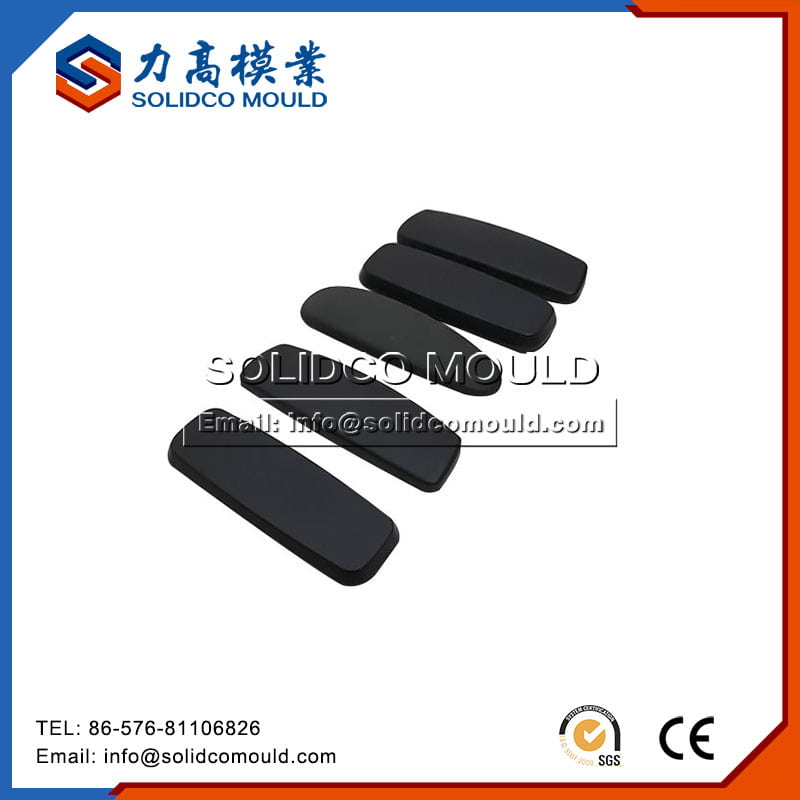
Armrest Cover mould2
| Location: | Zhejiang, China |
| Business Type: | Manufacturer, Exporter |
| Brands: | SOLIDCO |
| Certificate: | SGS,CE,CO,COC |
| Payment method: | T/T,L/C,Western Union |
| Minimum order quantity: | One Set |
| Price: | Consutation with customer’s requirement |
| Packing details: | wooden crate |
| Delivery time: | 30-60days |
E-mail: [email protected]