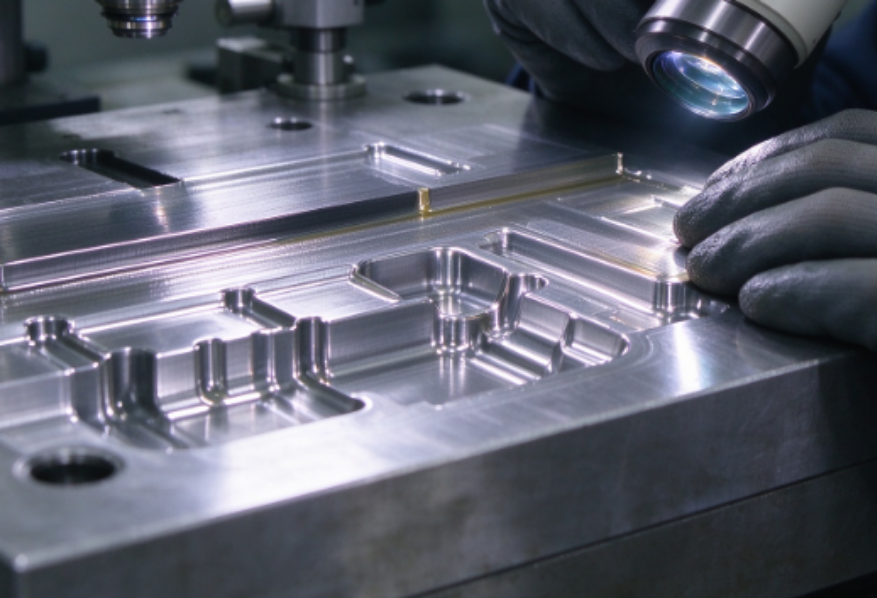
Why your mirror polish fails after chrome plating—and how to pick the right coating for wear, corrosion, or release.
At SOLIDCO MOULD, we hear this complaint monthly: “We spent a fortune on a PVD coating, but the mold rusted in three weeks.” Or: “We chrome-plated a mirror cavity, and now it’s covered in pinholes.”
The root cause is almost always the same: selecting a coating by hardness or price, instead of matching it to the mold’s actual failure mode.
Hard chrome, electroless nickel, and PVD are not interchangeable. They use different physics, behave differently in the tool, and solve different problems. Here is the engineering matrix we use to spec every coating.
1. The Contenders: Process & Positioning
1.1 Hard Chrome Plating (Electroplating)
Traditional electrolytic deposition of chromium. Bath temp: 50–60°C (no part distortion). Thickness: 5–20μm standard, up to 50μm+ for repair—the only process that can restore worn dimensions. Low cost, mature tech.
- Best for: Volume molds, low-corrosion, simple geometries.
1.2 Electroless Nickel (EN) Plating
Auto-catalytic chemical deposition of Ni-P alloy. No electricity = perfectly uniform thickness even in deep ribs and blind holes. As-plated: HV500–600; after bake: ~HV900–1000.
- Best for: Complex molds (threads, slides, deep cavities) needing uniform build-up and corrosion resistance.
1.3 PVD Coating (Physical Vapor Deposition)
Vacuum-deposited ceramic films: TiN, CrN, DLC. Ultra-thin (2–5μm), extreme hardness (HV2000–3500). Temp: 200–450°C (minimal distortion). Cannot restore dimensions.
- Best for: High-gloss, high-wear, high-volume precision tools.
2. The Performance Breakdown
| Property | Hard Chrome | Electroless Nickel | PVD (TiN/CrN/DLC) |
| Hardness | HV800–1100 | HV500→1000 (heat-treated) | HV2000–3500 |
| Wear Resistance | Good (decent vs. unfilled) | Similar to chrome (mid-wear) | Exceptional vs. glass fiber |
| Corrosion Resistance | ❌ Micro-cracks = acid paths | ✅ Dense, non-porous | ✅ CrN: excellent · ⚠️ TiN: poor |
| Uniformity | ❌ Edge buildup, thin in deep pockets | ✅ Perfect on complex shapes | ⚠️ Line-of-sight (shadows = thin) |
| Dimensional Impact | Significant (design for it) | Significant | Negligible (2–5μm) |
| Repairability | ✅ Can re-plate to size | ✅ Can re-plate | ❌ Must strip & redo entirely |
3. Field Selection: When to Use What
✅ Choose Hard Chrome When:
- Simple-cavity, high-volume molds on a budget.
- Resin is non-corrosive, <15% glass fill.
- You need to restore a worn core back to print (the only process that builds thickness economically).
- Caveat: For PVC/FR resins, only if mold is simple and maintenance is frequent.
✅ Choose Electroless Nickel When:
- Mold has deep ribs, threads, multi-slide inserts—anywhere uniformity is non-negotiable.
- Medium corrosion + medium wear on a precision tool where plating thickness variation would scrap tolerances.
- Small inserts, ejector pins, or slide ways needing even wear + rust protection.
✅ Choose PVD When:
- Glass-filled or mineral-filled resins (PA+GF, PBT+GF): PVD wear life is 3–5× hard chrome.
- Optical / mirror-finish molds: DLC or CrN lowers friction, eliminates drag marks, and won’t pit like chrome.
- Sticky resins (PA, POM, TPU): Low-friction coatings cut ejection force → fewer ejector pins, less part stress.
- Aggressive corrosion (PVC, FR): CrN is the gold standard—dense ceramic barrier, no micro-cracks.
4. The Four Costly Mistakes We Fix
- Mirror Polish + Hard Chrome = Disaster.
Chrome’s natural micro-cracks become pinholes after polishing. For optical surfaces, go PVD (DLC/CrN) or polish → ultra-thin chrome only. - PVD on Soft Substrate = “Thin Ice” Effect.
PVD is hard but thin. If base steel is <40 HRC, the coating cracks under load. Always nitride first, then PVD for high-stress molds. - TiN for Corrosion = Rust Guarantee.
TiN is hard but porous to gases. For FR/PVC, specify CrN—corrosion resistance is the priority, not just hardness. - Complex Geometry + Hard Chrome = Uneven Hell.
Deep pockets get thin plating; edges get thick. Result: premature failure in ribs. Electroless nickel is the uniform solution.
5. The Decision Flowchart
Ask: What is killing this mold?
- Wear (glass fiber)? → PVD (TiAlN/DLC)
- Corrosion (acids)? → CrN PVD or Electroless Nickel
- Sticking / Drag marks? → DLC PVD (lowest friction)
- Complex shape needing even coating? → Electroless Nickel
- Worn out & need to add steel back? → Hard Chrome (build-up)
- Budget + simple + mild conditions? → Hard Chrome
📩 Not Sure Which Coating Your Mold Needs?
At SOLIDCO MOULD, we don’t guess. Every tooling quote includes a coating recommendation based on your resin, volume, and failure history. Whether it’s a quick chrome touch-up or a full PVD stack, we’ll spec it right the first time.
Stop wasting money on the wrong surface treatment.
📩 [email protected] | 🌐 www.solidcomould.com | 📞 +86-18057673087
Follow SOLIDCO MOULD on [LinkedIn] for weekly tooling deep-dives from our engineering desk.