Subtitle: Why your “high-performance” nylon parts are failing—and how to fix it before it hits the assembly line.
In the world of engineering plastics, PA Nylon (Polyamide) is the undisputed workhorse. From high-stress automotive clips to precision electronic connectors, its toughness and wear resistance are legendary. Yet, for many injection molders, Nylon is a double-edged sword. Its high crystallinity and hygroscopic nature make it a frequent source of brittle fractures, silver streaks, and warpage.
At Solidco Mould, we’ve run millions of Nylon shots. We know that success isn’t just about melting plastic—it’s about controlling the physics. Here is our field-tested playbook to eliminate common PA defects and ensure your parts come out perfect, every time.
1. The Core Challenge: Understanding Nylon’s Temperament
Before you hit “Start,” you must respect the material. Nylon’s primary hurdles are:
- Hygroscopy: It absorbs moisture from the air like a sponge. In the barrel, this water turns to steam, causing silver streaks and hydrolysis (molecular degradation).
- High Crystallinity: This leads to significant shrinkage (up to 2%) and high internal stress if cooling isn’t uniform.
- Narrow Melt Window: Too hot, and it degrades; too cold, and you get short shots or “floating fibers.”
2. Defect Decoder: Causes & On-the-Fly Solutions
2.1 Brittleness & Low Impact Strength
- Root Cause: Inadequate drying is the #1 culprit. Overheating in the barrel and excessive regrind also break polymer chains.
- The Fix: Ensure your resin is “bone dry.” Keep mold temps above 80°C for PA66 to ensure proper crystallization. Limit regrind to 20%—for structural parts, virgin material is the only safe bet.
2.2 Silver Streaks & Internal Voids
- Root Cause: Moisture vaporization or trapped air.
- The Fix: Use a dehumidifying dryer (dew point < -40°C). If streaks persist, slow down your injection speed to reduce shear heat and check your vent depth (0.015–0.02mm).
2.3 Sink Marks & Shrinkage
- Root Cause: Uneven wall thickness and insufficient packing.
- The Fix: Use a 2-stage packing pressure. Hold pressure longer to feed material into thick sections as the part shrinks. If design allows, add ribs instead of thickening walls.
2.4 Warpage & Dimensional Instability
- Root Cause: Differential cooling between the core and cavity sides.
- The Fix: Maintain a <10°C temperature difference between core and cavity. Ensure balanced ejection pin layouts to prevent bending during part removal.
2.5 Flash (Burrs)
- Root Cause: Nylon’s high flowability under pressure.
- The Fix: Verify clamp tonnage. Reduce injection speed at the end of fill (packing phase). Ensure parting lines are clean and vents are not cut too deep.
3. The Production Protocol: Our 4-Step Control System
To move from “trial and error” to “consistent quality,” we enforce these non-negotiable standards:
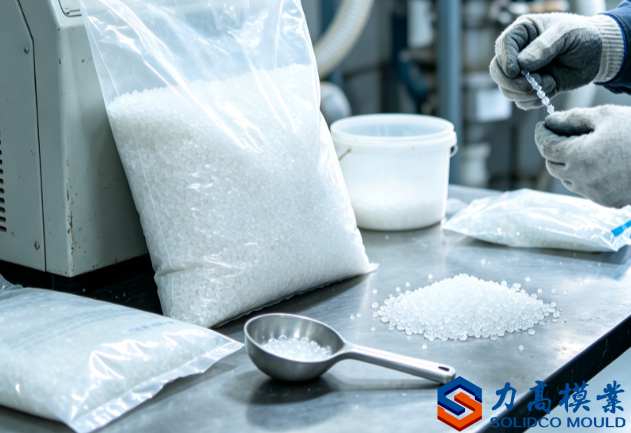
3.1 Drying Discipline
- PA6: 80–100°C for 4–6 hours.
- PA66: 100–120°C for 4–6 hours.
- Pro Tip: Perform the “bend test”—the pellet should bend, not snap. Never leave bags open on the shop floor.
3.2 Temperature Precision
- Barrel: PA6 (220–260°C), PA66 (250–290°C). Add 10–20°C for Glass-Filled grades.
- Nozzle: Keep it slightly cooler than the front zone to prevent drooling, but hot enough to prevent freezing.
3.3 Mold Temperature Control
- Standard Nylon: 60–80°C.
- GF Nylon: 80–100°C.
- Crucial: Use oil or water mold temperature controllers. Ambient air cooling leads to stress cracks.
3.4 The “Smart” Process Sequence
- Heat Soak: Ensure temps are stable before purging.
- Fill: Medium speed to avoid shear burn.
- Pack: High pressure, short time (to prevent sink).
- Hold: Lower pressure, longer time (to relieve stress).
4. Quality Assurance: The Final Check
Every 2 hours, we audit dryer temps. Every shift, we verify barrel temps. First-piece inspection is mandatory: We bend-test for toughness and measure critical dimensions before a single part hits the tote.
📩 Struggling with Nylon Molding? Let’s Talk.
If you are battling brittle parts, high scrap rates, or dimensional instability, you don’t need more guesswork—you need a precision partner. Our engineering team specializes in high-performance tooling and process optimization for even the most challenging engineering resins.
Ready to optimize your next PA Nylon project?
| 📞 Phone | +86-18057673087 |
| 📧 Email | [email protected] |